Empathy has become one of the most frequently cited qualities of modern leadership. It’s talked about online and in media articles. Company values promote it. Employees increasingly expect it. Yet for many people at work, empathy remains unevenly experienced – and often absent when it matters most.
Dale Carnegie’s latest State of Organisational Health Report suggests a significant gap between aspiration and reality. Just 12% of employees say they work in a deeply empathetic workplace, while 20% describe their organisation as low on empathy. The majority, 52%, sit in what the research calls “emerging empathy” cultures, where intent exists but behaviours are inconsistent.
So, although empathy is widely talked about, in reality, the majority of organisations don’t know how to embed it.
What is Empathy in Leadership?
Empathy in leadership is the ability to understand another person’s perspective, acknowledge their experience, and respond with respect, while still holding people accountable for results. It is not about being soft; it is about building trust, clarity, and performance through how leaders listen, communicate, and act.
Empathy as a Business Issue
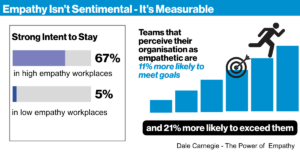
For years, empathy was dismissed as a “soft” concern – desirable, perhaps, but secondary to results. The data now tells a different story.
Why Empathy Breaks Down at Work
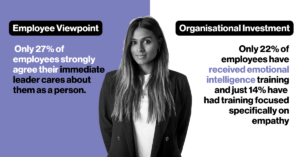
Part of the answer lies in how organisations think about empathy in leadership. Empathy is often treated as a personal trait – something leaders either possess naturally or don’t. The reality is, many managers care deeply but are promoted for technical skill, not people capability, and are rarely taught how to demonstrate empathy clearly, especially under pressure.
From Value to Practice
The organisations that are making progress tend to approach empathy differently. Rather than treating it as a value statement, they treat it as a leadership capability – one that can be defined, developed and reinforced.
High‑empathy organisations are explicit about what empathy looks like in action. That means clarifying how leaders are expected to behave during performance conversations, in moments of change, and when pressure is high. Empathy becomes something observable, not just something leaders intend to show.
Crucially, empathy is not developed in isolation. The most effective organisations build it alongside communication, influence, accountability and emotional intelligence. When empathy sits within this broader skill set, it supports performance rather than competing with it.
Another defining feature is the quality of conversations managers have with their teams. Dale Carnegie research shows that regular, structured conversations are one of the strongest predictors of how empathetic employees perceive their organisation to be. Leaders who are trained to listen, ask meaningful questions and respond constructively tend to build higher trust and engagement over time.
Finally, empathy becomes sustainable when it is reinforced by organisational systems. Culture is shaped by what organisations measure, reward and role‑model. When empathetic behaviours are embedded into leadership frameworks, performance expectations and recognition systems, they become consistent and not optional.
Five Practical Ways Leaders Can Show More Empathy at Work
The good news is, that empathy can be learnt and it does not require grand gestures. In practice, it shows up in small, deliberate behaviours that are repeated consistently – especially when time is limited or pressure is high.
1. Listen to Understand, Not to Respond
Empathy starts with attention. That means staying present, limiting distractions, and resisting the urge to problem-solve immediately. Leaders who listen fully, without interrupting or preparing their next point, signal that the person in front of them matters.
Example: A useful discipline is to summarise what you have heard before responding. This confirms understanding and helps employees feel genuinely heard.
2. Acknowledge Feelings Before Facts
Leaders often move quickly to data, logic and solutions. Empathy requires a pause to acknowledge how something feels before addressing what needs to be done.
Example: Simple statements such as “That sounds frustrating” or “I can see why this has been challenging” help people feel seen and make problem-solving easier.
3. Ask Open, Human Questions
Empathetic leaders ask questions that invite reflection, not just reports.
Example: Rather than “Are you okay with the deadline?”, ask:
- “What’s feeling most demanding about this right now?”
- “What support would be most helpful this week?”
These questions deepen understanding without lowering expectations.
4. Balance Care with Accountability
Empathy is not about removing standards. It is about recognising people’s reality while still being clear about outcomes.
Example: This might sound like: “I know there’s a lot on your plate, and the deadline still matters. Let’s talk about how we approach it together.” When care and accountability coexist, trust increases.
5. Be Consistent – Especially Under Pressure
Empathy matters most when stress is high. Leaders who remain respectful, curious and calm during tense moments build credibility and psychological safety over time. Consistency turns empathy from a personality trait into a leadership habit.
Empathy Training
Dale Carnegie’s leadership training framework is clear: emotional awareness alone does not change performance. Awareness must be translated into action.
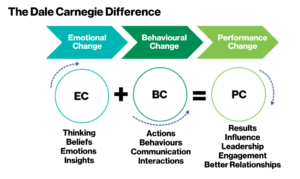
This is where leadership development and empathy training plays a decisive role. Across Dale Carnegie’s core programmes, including the Dale Carnegie Course, Develop Your Leadership Potential, and Leadership Training for Results , empathy is embedded through practical skill‑building in communication, trust, influence and accountability.
For organisations seeking broader change, Dale Carnegie also partners on in‑house solutions, ranging from short, targeted workshops to full culture programmes designed to embed empathetic leadership at scale.
Example in Practice
A manager becomes emotionally aware that a team member has disengaged after repeated deadline issues (emotional change). Instead of reacting with frustration, the manager pauses, acknowledges the individual’s perspective in a one‑to‑one conversation, listens without judgement, and agrees clear expectations and support going forward (behaviour change). As a result, trust improves, performance stabilises, and deadlines are met consistently again – performance change.
Awareness created insight, but it was the change in leadership behaviour that produced results. This is the distinction at the heart of Dale Carnegie’s framework.
Beyond Good Intentions
The gap between how much empathy is valued and how often it is experienced suggests a shift underway in workplaces. Empathy is no longer being debated as a moral ideal. It is increasingly understood as a leadership capability – one that can be built deliberately, reinforced systematically and measured over time. The organisations that succeed will be those that move beyond good intentions and learn how to operationalise empathy in the realities of everyday work.
To learn more about about Dale Carnegie’s research into empathy in leadership, read our whitepaper: The Power of Empathy – A Key Soft Skill for the Future of Work
Get in touch if you’d like to know more.