
A Lesson From Dale Carnegie That Still Matters 90 Years Later
What criticism does to other people, what it does to us, and why one of Dale Carnegie’s simplest principles may be more important than ever.
 Ninety years ago, Dale Carnegie wrote the worldwide best-seller, How to Win Friends and Infleunce People and he shared a principle that seemed simple at the time:
“Don’t criticise, condemn or complain.”
In today’s world, it feels almost radical. We live in an age where criticism is everywhere.
Social media rewards outrage. News headlines compete for attention. Workplace conversations can quickly become fault-finding exercises. Even the voice inside our own heads can sometimes become our harshest critic.
It’s easy to dismiss Carnegie’s advice as old-fashioned. After all, surely people need feedback. Surely mistakes need addressing.
Of course they do.
But Carnegie’s point was never that we should ignore problems. His insight was that criticism is rarely as effective as we think it is.
Perhaps the reason this principle has endured for 90 years is because criticism doesn’t just affect the person receiving it. It affects the person giving it too.
And all too often, it affects the person looking back at us in the mirror.
What criticism does to other people?
Most people don’t respond positively to criticism.
They become defensive. They justify their actions. They stop listening.
Even when the criticism is accurate.
One of Carnegie’s key observations was that people rarely see themselves as the villain in their own story. When someone feels attacked, their natural response is often to protect themselves rather than reflect on what they could do differently.
Modern workplace research supports this idea.
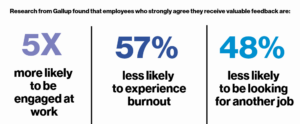
The difference isn’t whether feedback is given. It’s how it’s given.
That’s an important distinction.
The most effective leaders don’t avoid difficult conversations. They simply approach them differently. They focus on learning rather than blame, understanding rather than judgement, and improvement rather than punishment.
The goal isn’t to lower standards.
It’s to create the conditions where people are willing to improve.
What Criticism Does to Us
It’s easy to think criticism only affects the recipient. But criticism changes the critic too.
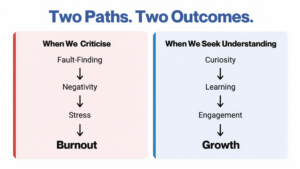
The more we focus on faults, mistakes and shortcomings, the more likely we are to see the world through that lens.
We start noticing what’s wrong before we notice what’s right. Colleagues become frustrating. Customers become difficult. Meetings become annoying. Problems become bigger than possibilities.
Over time, criticism can become a habit. And habits become mindsets.
Research into workplace incivility has consistently found links between negative workplace interactions and higher levels of stress and burnout, as well as lower job satisfaction, reduced organisational commitment and greater intentions to leave an organisation.
In other words, criticism doesn’t just have consequences for the people around us.
It can shape the way we experience our work, our relationships and our daily lives.
One of the hidden lessons in Carnegie’s principle is that criticism doesn’t just shape relationships. It shapes perspective.
What self criticism does to ourselves
Perhaps the most damaging criticism isn’t directed at others at all. It’s directed at ourselves.
Most of us would never speak to a colleague, friend or family member in the same way we sometimes speak to ourselves.
“You should be doing better.”
“That wasn’t good enough.”
“Everyone else seems to have it figured out.”
“You’ll probably get it wrong again.”

A certain degree of self-reflection is healthy.
It helps us learn, adapt and improve.
But self-reflection and self-criticism are not the same thing.
Healthy reflection asks:
“What can I learn from this?”
Harsh self-criticism asks:
“What’s wrong with me?”
Research has linked high levels of self-criticism with increased vulnerability to anxiety, depression, lower self-esteem and emotional distress. Self-acceptance and self-compassion, on the other hand, have been shown to support emotional wellbeing and reduce anxiety and related depression.
Many high achievers wear self-criticism as a badge of honour. They believe being hard on themselves is what drives success.
But there is growing evidence that relentless self-judgement often fuels perfectionism, stress and emotional exhaustion rather than sustained performance. Research also suggests that environments where people feel psychologically safe to make mistakes and learn from them often outperform environments where perfection is expected.
Just as people perform better when they feel encouraged by others, we often perform better when we offer ourselves a little more understanding and a little less judgement.
Why This Matters More Than Ever
When Dale Carnegie first published How to Win Friends and Influence People in 1936, criticism travelled slowly. Today it moves at the speed of a click.
- We can criticise colleagues in a Teams message.
- We can criticise strangers on social media.
- We can criticise organisations from behind a keyboard.
- And many of us carry around an internal critic that’s constantly evaluating our performance, appearance, achievements and worth.
At the same time, work has become faster, more connected and more demanding. We’re surrounded by more opinions, more comparisons and more opportunities to judge than at any point in history.
Perhaps that’s why this principle feels even more relevant today than it did ninety years ago.
Not because people have changed. But because the opportunities to criticise, condemn and complain have multiplied.
A Different Approach
Carnegie wasn’t suggesting we avoid accountability. He wasn’t suggesting we ignore mistakes. And he certainly wasn’t suggesting we lower expectations.
His lesson was much deeper – people are more likely to grow when they feel understood than when they feel attacked.
✓ That applies to our colleagues.
✓ It applies to our customers.
✓ It applies to our families.
✓ And it applies to ourselves.
The best leaders don’t ignore problems – they address them without attacking the person.
The most resilient people don’t ignore mistakes – they learn from them without turning them into a source of self-punishment.

90 Years Later, the Lesson Still Stands
The world has changed dramatically since 1936.
Television arrived. The internet arrived. Smartphones arrived. Artificial intelligence arrived.
Yet one thing remains true:
People are more likely to grow through understanding than judgement.
Whether we’re speaking to a colleague, a customer, a friend, a family member or ourselves, understanding tends to achieve what judgement cannot.
That’s why, ninety years later, one of Dale Carnegie’s simplest principles remains one of his most powerful:

Because the way we speak to others shapes relationships.
The way we speak about others shapes our outlook.
And the way we speak to ourselves shapes who we become.