Why critical thinking is becoming the most valuable capability in modern organisations.
 There’s a new risk in business, and it’s not what most leaders think
AI is transforming how work gets done.
It can generate ideas, analyse data, and recommend decisions in seconds. For many organisations, it promises efficiency, speed, and scale.
But beneath that opportunity lies a growing risk – one that isn’t about the technology itself.
It’s about how people use it.
According to a recent Dale Carnegie whitepaper – Critical Thinking in Modern Business Environments, the real issue isn’t system failure – it’s the judgement failure around it.
And in today’s decision environments, that failure can spread fast.
This is why organisations investing in leadership development programmes are increasingly focusing not just on capability, but on decision quality.
From information overload to “confidence saturation”
For years, we’ve talked about information overload.
Too much data. Too many inputs. Not enough time.
But the challenge has evolved.
Today, we’re facing something more subtle: confidence saturation.
AI outputs are:
- Polished
- Complete
- Delivered with apparent certainty
And that confidence can create a dangerous shortcut – acceptance without questioning. This matters because:
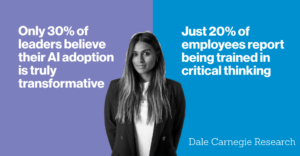
In other words, organisations are upgrading capability faster than they’re upgrading judgement.
Many organisations are now addressing this through management training – not just technical skills.
So, what is critical thinking in 2026?
Critical thinking isn’t just analysis. And it’s no longer just an individual skill.
It’s the ability to:
- Define problems clearly
- Interrogate information and sources
- Challenge assumptions
- Make decisions with clarity and accountability
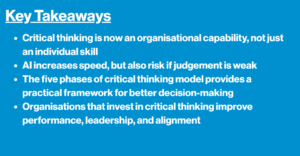
But more importantly – it’s becoming an organisational capability.
This is why it’s increasingly embedded into organisational development solutions rather than treated as standalone training.
The five phases of critical thinking—reimagined for the AI workplace
While the framework itself isn’t new, the way it’s applied has changed dramatically.
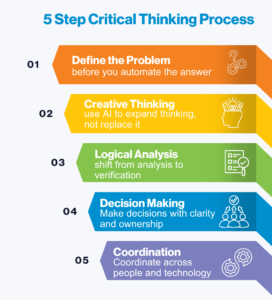
Here’s how the five phases come to life in today’s working environment:
1. Define the problem before you automate the answer
In fast-moving teams, there’s pressure to act quickly – often by jumping straight into solutions or prompting AI for answers.
But the first and most important step is still: are we solving the right problem?
- Should this even be automated?
- Where does human judgement matter most?
- Could technology distort the real objective?
Strong problem definition is a core part of effective leadership capability development, particularly during growth and transformation.
2. Use AI to expand thinking not replace it
AI is a powerful ideation partner. But it also creates risk.
One of the most common? Premature convergence.
- Accepting the first plausible answer
- Anchoring too quickly on AI-generated ideas
- Losing diversity in thinking
Strong critical thinkers:
- Treat AI outputs as inputs—not conclusions
- Generate their own alternatives
- Deliberately challenge patterns
This capability is central to improving communication and collaboration within teams.
3. Shift from analysis to verification
In the past, this stage was about evaluating options.
Now, it’s also about validating the system behind them.
- Where did this data come from?
- What assumptions shaped this output?
- Could there be bias or gaps?
This level of rigour is increasingly embedded within decision-making skills for managers.
4. Make decisions with clarity and ownership
AI can recommend. It can model. It can accelerate.
But it cannot take accountability.
- Understand risk and consequences
- Assess reversibility
- Be explicit about ownership
Organisations that invest in management training see stronger accountability and faster execution.
5. Coordinate across people and technology
Execution has changed.
It’s no longer just teams delivering outcomes it’s hybrid systems of people and technology working together.
Critical thinking here means:
- Defining where Humans vs AI takes the lead
- Make decision logic visible
- Ensure consistency across teams
This is a key focus area in /organisational-development and strengthening alignment.
Why this matters for organisations
For businesses this isn’t theoretical.
It shows up every day in:
- Leadership capability gaps
- Communication breakdowns
- Slower decision-making
- Increased rework and inefficiency
Especially during:
- Periods of growth
- Organisational transformation
- Leadership transitions
The difference between progress and friction often comes down to the quality of thinking across the organisation.
From individual skill to business advantage
Critical thinking is no longer something you hope individuals bring.
It’s something organisations must build deliberately.
- Improves decision speed and accuracy
- Strengthens leadership capability
- Increases accountability and alignment
- Reduces costly mistakes
- Supports long-term performance
It turns good organisations into consistently effective ones.
Turning critical thinking into capability
The challenge isn’t awareness – it’s application.
- Practised consistently
- Applied to real business challenges
- Reinforced by leaders
- Embedded into everyday workflows
This is where structured /critical-thinking-training and critical thinking workshops make the difference.
How We Can Help
At Dale Carnegie UK, we help organisations go beyond theory and build critical thinking as a practical, measurable capability.
Our programmes are designed for organisations that want to:
- Strengthen leadership and management effectiveness
- Improve communication and collaboration
- Make better decisions in fast-moving environments
- Support growth, transformation, and performance
Contact us to learn more