
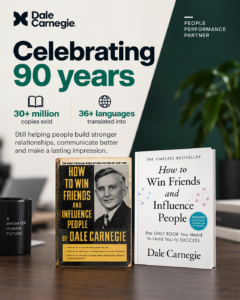
 In November, one of the world’s most influential personal development books celebrates a remarkable milestone. How to Win Friends and Influence People turns 90.
First published in 1936, the book has sold more than 30 million copies worldwide and has been translated into numerous languages, becoming one of the most enduring personal development books ever published.
Long before social media, podcasts, LinkedIn influencers and personal brands, Dale Carnegie was teaching people how to build trust, strengthen relationships, communicate effectively and positively influence others. In many ways, you could argue that Dale Carnegie was the original influencer. Of course, the world he wrote for looked very different from the one we live in today. There were no smartphones. No video calls. No instant messaging. And certainly no artificial intelligence.
Yet, despite everything that has changed over the past nine decades, millions of people continue to discover, recommend and benefit from the book. Why?
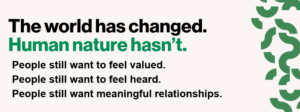
People still respond better to encouragement than criticism, appreciation than indifference and understanding than judgement.
That’s why the principles at the heart of How to Win Friends and Influence People continue to resonate.
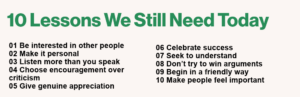
Putting It Into Practice
01. Become Interested in Other People
“You can make more friends in two months by becoming interested in other people than you can in two years by trying to get other people interested in you.”
In a world focused on personal brands and self-promotion, this lesson feels more important than ever.
The people who build the strongest relationships aren’t always the ones doing the most talking. They’re the ones asking thoughtful questions, listening carefully and showing genuine curiosity about others.
Whether you’re meeting a potential client, networking on LinkedIn or leading a team, being interested will always be more powerful than trying to be interesting.
02. Make It Personal
“Remember that a person’s name is to that person the sweetest and most important sound in any language.”
Technology has made communication faster, but it has also made it easier to be impersonal.
Remembering someone’s name, acknowledging their contribution or personalising a message demonstrates respect and attention.
In a world increasingly influenced by automation, small human touches can make a big difference.
03. Listen More Than You Speak
“Talk to someone about themselves and they’ll listen for hours.”
People want to feel heard.
Whether you’re leading a one-to-one, conducting a customer meeting or talking with colleagues, active listening remains one of the most valuable communication skills we can develop.
The best communicators don’t focus solely on what they want to say.
They focus on understanding the person in front of them.
04. Choose Encouragement Over Criticism
“Any fool can criticise, condemn and complain – and most fools do.”
Social media has made criticism easier than ever.
Constructive feedback has an important place, but criticism alone rarely inspires change.
Great leaders understand that people are more likely to improve when they feel supported, encouraged and respected.
The goal isn’t to avoid difficult conversations. It’s to make those conversations constructive.
05. Give Genuine Appreciation
“Give honest and sincere appreciation.”
Recognition never goes out of style.
Everyone wants to know that their effort matters.
A genuine thank you, recognition of a job well done or acknowledgement of someone’s contribution can have a much greater impact than we sometimes realise.
Appreciation is simple, but powerful.
06. Celebrate Success
“Be hearty in your approbation and lavish in your praise.”
Many organisations are quick to identify what’s wrong and slower to recognise what’s right.
Celebrating progress, effort and achievement helps people know their contribution is seen and valued.
And celebration doesn’t have to mean a major award or grand gesture.
Sometimes it’s simply taking the time to notice what went well and say so.
07. Seek to Understand
“If there is any one secret of success, it lies in the ability to get the other person’s point of view.”
Empathy has become an increasingly important part of modern leadership.
Understanding another person’s perspective can improve communication, reduce conflict and help build trust.
Whether you’re managing a team, serving customers or leading organisational change, seeing the situation through someone else’s eyes can change the conversation.
08. Don’t Try to Win Arguments
“The only way to get the best of an argument is to avoid it.”
This lesson feels particularly relevant today.
Too many conversations become contests to determine who’s right.
Yet genuine influence rarely comes from winning an argument. It comes from asking questions, looking for common ground and helping other people feel understood.
Winning the argument isn’t always the same as winning someone over.
09. Begin in a Friendly Way
“Begin in a friendly way.”
Sometimes the simplest principles are the easiest to overlook.
Whether you’re delivering feedback, leading a difficult conversation or introducing a new idea, your approach helps determine how your message will be received.
People are naturally more open to a conversation when they feel respected.
How we begin matters.
10. Make People Feel Important
“Make the other person feel important – and do it sincerely.”
If one principle captures the spirit of the book, this may be it.
People remember how interactions make them feel.
Making someone feel valued isn’t simply a relationship skill.
It’s a leadership skill. A customer service skill. A sales skill. And a life skill.
Why Has This Book Stood the Test of Time?
Very few books remain influential after ninety years.
Perhaps the reason is simple: How to Win Friends and Influence People isn’t really a book about business, leadership, networking or sales.
It’s a book about people.
Technology has transformed how we work and communicate, but the human skills that build trust and strengthen relationships haven’t changed.

90 Years On
At Dale Carnegie, we’re proud to build on the principles that first made the book a global bestseller, helping people develop the human skills that turn potential into performance.
Because organisations succeed when people succeed.